Online reviews are not a marketing tactic. They are a revenue channel.
For contractors -- plumbers, electricians, HVAC technicians, roofers, handymen -- reviews are often the single largest factor separating a business that books ten jobs per week from one that books forty. The data is unambiguous: review quantity, quality, recency, and your response patterns directly determine how many people find you, trust you, and call you.
This is not a feel-good article about "the importance of customer feedback." This is a revenue operations guide. Every recommendation is backed by specific data from specific sources, and every framework is designed to be executed in fifteen minutes per week.

The Numbers: Why Reviews Are a Revenue Event
The BrightLocal Local Consumer Review Survey 2026 -- the most comprehensive annual study on review behavior, surveying thousands of consumers -- delivered findings that should alarm any contractor operating below 4.5 stars:
- 97% of consumers read reviews before choosing a local business (BrightLocal, 2026)
- 41% read reviews every single time they search for a business, up from 29% in 2025 (BrightLocal, 2026)
- 31% of consumers will only use a business with 4.5 stars or higher, up from 17% in 2025 -- nearly doubling in one year (BrightLocal, 2026)
- 68% will only use a business with 4+ stars (BrightLocal, 2026)
- The average consumer checks six different review sites before making a decision (BrightLocal, 2026)
The revenue implications are direct. Harvard Business School research found that a one-star increase in Yelp rating leads to a 5-9% increase in revenue (Luca, 2016). Trustmary's 2025 analysis found that businesses with 200 or more reviews earn twice the revenue of businesses without reviews (Trustmary, 2025). And the downside is equally severe: one negative review costs a business approximately 22% of its potential customers, while four or more negative reviews can drive away 70% of prospects (ReviewsOnMyWebsite, 2025; Marquiz, 2025).
For a contractor averaging $5,000 per job with 100 monthly website visitors converting at 8%, the math looks like this:
| Scenario | Monthly Conversions | Monthly Revenue | Annual Revenue | |---|---|---|---| | Current (4.0 stars, 45 reviews) | 8 | $40,000 | $480,000 | | Improved (4.5 stars, 120 reviews) | 11-13 | $55,000-$65,000 | $660,000-$780,000 | | Degraded (3.5 stars, same reviews) | 4-5 | $20,000-$25,000 | $240,000-$300,000 |
The delta between a well-managed and poorly-managed review profile is $300,000 to $540,000 per year for a single-location contractor. Reviews are not a nice-to-have. They are a six-figure revenue variable.
Reviews as a Local SEO Ranking Factor
Reviews do not just influence consumer behavior. They directly influence whether Google shows your business at all.
Google's own documentation states that "more reviews and positive ratings can improve your business's local ranking" (Google Business Profile Help, 2026). Reviews are one of three core local ranking factors alongside relevance and distance.
The data from industry research confirms the weight:
- Google reviews account for approximately 20% of local pack ranking influence (WiserReview, 2026, citing Whitespark data)
- Review recency is now a top-5 local ranking factor, according to Whitespark's 2026 Local Search Ranking Factors report. Darren Shaw, Whitespark's founder, wrote: "I think Google has cranked the dial on this factor" (Whitespark, 2025)
- Review velocity -- the rate at which new reviews arrive -- signals to Google that your business is active and relevant
- Review keywords matter: reviews that naturally mention services ("fixed my furnace," "replaced the water heater") provide Google with relevance signals for those search queries
This means a contractor who stops generating reviews for three months does not just lose social proof with consumers. They lose ranking visibility in Google's local pack -- the three-business box that captures the majority of local search clicks.
The Whitespark 2026 report, compiled from surveys of 47 top local SEO experts evaluating 187 ranking factors, identified review signals as one of the most heavily weighted categories for local pack rankings. The specific factors that matter most, in order: review quantity, review velocity, review diversity (across platforms), review content, and owner response patterns.
The Review Revenue Engine: A Framework for Systematic Growth
Most contractors approach reviews reactively. A customer complains, they respond. A customer praises them, they feel good about it. There is no system, no measurement, no compounding.
The Review Revenue Engine is a four-stage framework designed to turn reviews from a passive reputation indicator into an active revenue driver.
Stage 1: Foundation (Weeks 1-4)
Goal: Establish baseline metrics and close critical gaps.
Audit your current position: - Total review count across Google, Yelp, Facebook, Angi, HomeAdvisor, BBB - Average star rating on each platform - Review recency (date of most recent review on each platform) - Response rate (percentage of reviews you have responded to) - Review velocity (average reviews per month over the past 6 months)
Benchmark against competitors: Pull the review profiles of the top 5 contractors in your area for your primary service. If they average 180 reviews and you have 40, you know the gap. If they are getting 8 reviews per month and you are getting 2, you know the velocity deficit.
Close the response gap: Respond to every existing unanswered review -- positive and negative. BrightLocal's 2026 survey found that slow or generic review responses are increasingly viewed as a red flag by consumers. The expectation is near-immediate acknowledgment.
Stage 2: Acceleration (Weeks 5-12)
Goal: Build a repeatable review generation system.
The single highest-impact action a contractor can take is asking for reviews at the right moment. Research consistently shows that 71% of consumers will leave a review if the business makes it easy and asks at the point of satisfaction (Trustmary, 2025).
The "Completion Moment" method:
- 1.Identify the peak satisfaction moment. For most contractors, this is immediately after job completion when the customer sees the finished work. Not the next day. Not via email three days later. Right then.
- 1.Use a two-sentence script. Keep it natural: "We are glad you are happy with the work. Would you mind leaving us a quick Google review? It really helps other homeowners find us." No begging. No incentivizing (which violates Google's policies). Just a direct, human ask.
- 1.Remove all friction. Have a direct link to your Google review page ready on your phone. Text it to the customer on the spot. The link format is: `https://search.google.com/local/writereview?placeid=YOUR_PLACE_ID`. Every additional click between the ask and the review submission reduces completion rates dramatically.
- 1.Systematize the ask. Every technician, every job, every time. This is not optional for whoever feels like it. It is a standard operating procedure, like cleaning up the work site before leaving.
Target velocity: Aim for a minimum of 4-8 new Google reviews per month for a single-location contractor. At this rate, you will meaningfully close the gap with competitors within one to two quarters.
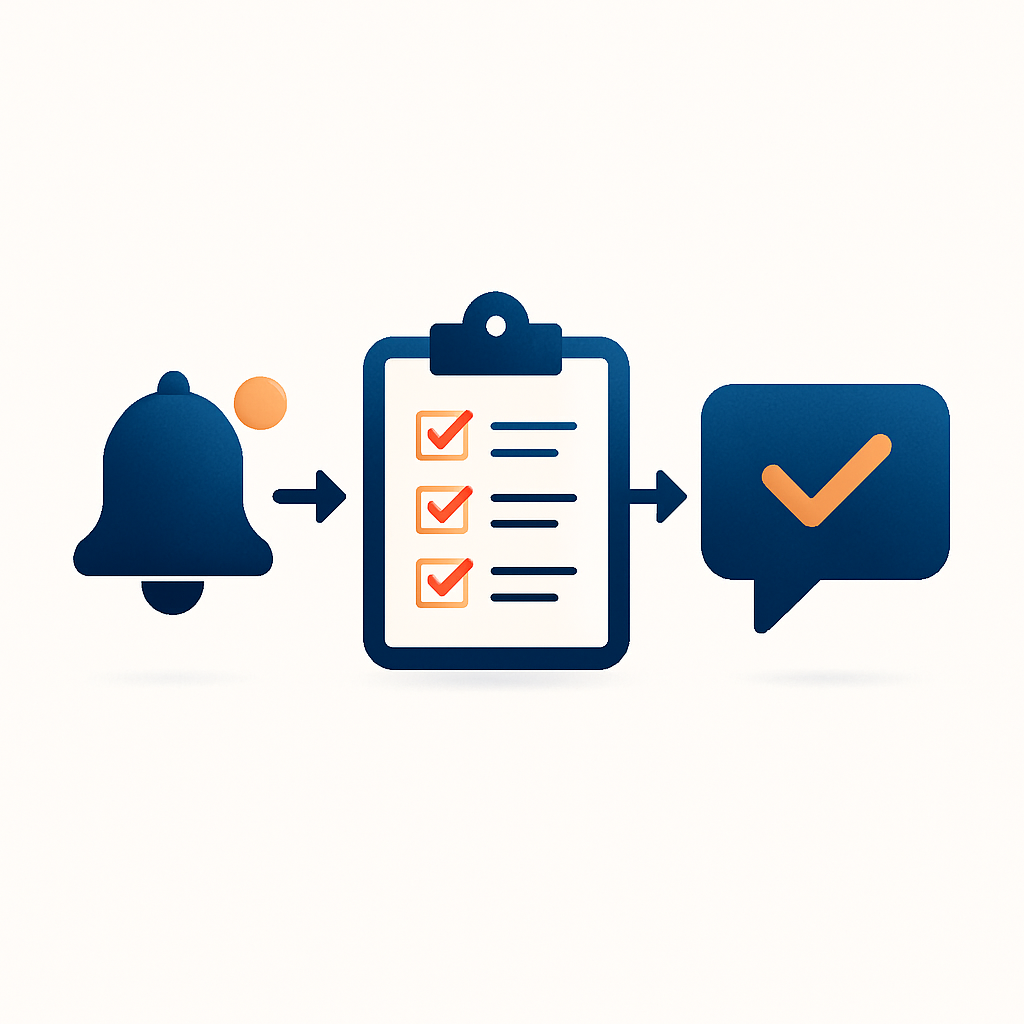
Stage 3: Optimization (Months 3-6)
Goal: Improve review quality and diversify across platforms.
Not all reviews carry equal weight. A review that says "Great service, 5 stars" helps your rating but provides minimal SEO value or consumer persuasion. A review that says "Called at 7 AM for an emergency pipe burst. Mike arrived within 45 minutes, diagnosed the issue immediately, replaced the section of pipe, and cleaned up completely. Fair price at $380 for emergency service" -- that review sells your business to every future reader and feeds Google specific service keywords.
How to encourage detailed reviews without scripting them:
- Ask specific questions when requesting the review: "Would you mind mentioning what service we did and how the experience went?" This naturally produces keyword-rich content.
- Follow up with a brief text: "Thanks again for choosing us for your [specific service]. If you have a moment to share your experience on Google, it helps other homeowners in [city/neighborhood] find reliable help."
- Never provide review text for customers to copy. Google's spam detection algorithms identify suspicious patterns in review language and can flag or remove them.
Diversify platforms: Google dominates, but BrightLocal's 2026 data shows consumers check an average of six review sites. Ensure you have an active presence on: - Google Business Profile (primary -- this feeds local pack rankings) - Yelp (still the #2 review platform for home services) - Facebook (especially for older demographics) - Angi / HomeAdvisor (industry-specific, feeds lead generation) - BBB (trust signal, especially for higher-value jobs) - Nextdoor (hyperlocal, high-trust neighborhood recommendations)
Stage 4: Compounding (Ongoing)
Goal: Turn your review profile into a sustainable competitive moat.
At this stage, you have a strong review count, a high rating, consistent velocity, and presence across multiple platforms. The focus shifts to maintaining and compounding.
The 15-Minute Weekly Review Routine:
| Day | Task | Time | |---|---|---| | Monday | Check all platforms for new reviews, respond to each | 10 min | | Monday | Review weekly velocity -- are you on track for 4-8/month? | 2 min | | Monday | Flag any negative reviews for follow-up action | 3 min |
That is it. Fifteen minutes per week to manage what is likely a six-figure revenue channel.
Responding to negative reviews -- the ARISE framework:
- 1.Acknowledge the issue without being defensive
- 2.Restate the concern to show you understood
- 3.Inform what corrective action you took or will take
- 4.Suggest moving the conversation offline (provide a direct phone number)
- 5.Express commitment to making it right
Example: "Thank you for sharing this feedback. We understand the delay in arrival was frustrating, and you are right to expect better communication when schedules shift. We have since implemented real-time text updates for all scheduled appointments so customers always know our ETA. I would like to discuss this further and make it right -- please call me directly at [number]. We appreciate the opportunity to improve."
This response pattern accomplishes three things: it shows future readers you take complaints seriously, it demonstrates professionalism, and it often results in the reviewer updating or removing their negative review after resolution.
The AI Factor: Reviews in the Age of ChatGPT and Google AI Overviews
BrightLocal's 2026 survey revealed a seismic shift: AI tools like ChatGPT have surged into third place (behind Google and Facebook) as a source for local business recommendations. Consumers are increasingly asking AI assistants "Who is the best plumber in [city]?" and expecting useful answers.
Where do AI models get their local business recommendations? Primarily from review data, business listings, and structured web content. A contractor with 200 reviews, a 4.7-star rating, detailed review content mentioning specific services and locations, and consistent owner responses across platforms is exponentially more likely to be cited by an AI assistant than a competitor with 30 reviews and a 4.1 rating.
This is the convergence point between reviews, local SEO, and Generative Engine Optimization (GEO). Your review profile is not just a trust signal for human visitors -- it is training data and citation material for AI systems that will increasingly control how consumers discover local services.
The businesses that build robust, authentic, keyword-rich review profiles now will have a compounding advantage as AI search grows. Those that ignore reviews will become invisible twice -- once in traditional search, and again in AI recommendations.
The Review Audit Checklist
Use this checklist to assess your current review position and identify gaps:
Quantity - [ ] 50+ Google reviews (minimum competitive threshold in most markets) - [ ] 100+ Google reviews (strong competitive position) - [ ] Active profiles on at least 3 additional review platforms - [ ] Review count within 75% of top local competitor
Quality - [ ] Average rating of 4.5+ stars on Google - [ ] Average rating of 4.0+ on all secondary platforms - [ ] At least 30% of reviews mention specific services by name - [ ] At least 20% of reviews mention your city or neighborhood
Recency - [ ] Most recent Google review within the past 7 days - [ ] Minimum 4 new reviews per month (velocity) - [ ] No platform has gone 30+ days without a new review
Responsiveness - [ ] 100% of negative reviews have a response within 24 hours - [ ] 90%+ of all reviews (positive and negative) have a response - [ ] Responses are personalized, not copy-pasted templates - [ ] Negative review responses follow the ARISE framework
Competitive Position - [ ] Your review count exceeds the local pack average - [ ] Your star rating matches or exceeds the local pack average - [ ] Your review velocity matches or exceeds top competitors
Common Mistakes That Kill Review Momentum
Mistake 1: Incentivizing reviews. Offering discounts or gift cards for reviews violates Google's policies and risks having your entire review profile flagged. Google's August 2025 spam update specifically targeted fake engagement patterns. The penalty is not a slap on the wrist -- it can mean removal of reviews or suspension of your Business Profile.
Mistake 2: Only asking happy customers. This is called "review gating" and Google explicitly prohibits it. You must provide the same review opportunity to all customers. The good news: if you consistently deliver quality work, the math works in your favor. Most satisfied customers will leave positive reviews when asked; most dissatisfied customers will contact you directly before going public if you have established a relationship during the job.
Mistake 3: Responding only to negative reviews. When consumers see a business that only responds to complaints, it signals that the business is in damage-control mode rather than genuinely engaged. Respond to positive reviews too -- a brief "Thank you, we appreciate your trust" is sufficient.
Mistake 4: Batch-requesting reviews. Sending review requests to 50 past customers on the same day creates an unnatural velocity spike that Google's systems can detect. Space requests naturally by building the ask into your job completion workflow.
Mistake 5: Ignoring non-Google platforms. Google is the priority, but consumers check an average of six sites. A contractor with 200 Google reviews and zero Yelp reviews looks suspicious. Distribute your efforts: roughly 60% Google, 15% Yelp, 10% Facebook, 15% other platforms.
What This Means for Your Website
Your website and your review profile are not separate marketing channels. They are interconnected systems.
A high-performing contractor website should: - Display review counts and ratings prominently on the homepage and service pages - Embed recent Google reviews using structured data markup (schema.org/Review) so search engines can display star ratings in organic results - Link directly to review profiles from the website footer and contact page - Include testimonial sections with detailed, attributed reviews that reinforce service quality - Load fast enough that visitors arriving from a Google search do not bounce before seeing your review proof -- every second of load time costs conversions
The businesses that treat their website and review profile as a unified system -- each reinforcing the other -- consistently outperform those that manage them in isolation.
The Bottom Line
Reviews are the highest-ROI marketing activity available to contractors. The investment is fifteen minutes per week and a consistent ask at job completion. The return is measurable in ranking visibility, consumer trust, competitive positioning, and direct revenue.
The data does not leave room for ambiguity: - 97% of consumers read reviews (BrightLocal, 2026) - A one-star improvement drives 5-9% revenue increase (Harvard Business School) - Businesses with 200+ reviews earn 2x the revenue (Trustmary, 2025) - Review recency is a top-5 local ranking factor (Whitespark, 2026) - 31% of consumers now require 4.5+ stars, up from 17% last year (BrightLocal, 2026)
The Review Revenue Engine framework gives you the system: Foundation, Acceleration, Optimization, Compounding. The ARISE framework gives you the response protocol. The 15-minute weekly routine gives you the execution cadence.
Every week you delay building this system, your competitors are pulling ahead -- in review count, in ranking position, in AI citation likelihood, and in revenue. The gap compounds. Start this week.