Website speed isn't a technical nicety. It's a revenue lever.
Yottaa's 2025 Web Performance Index (500M+ visits, 1,300+ websites): 63% of visitors bounce from pages taking over 4 seconds to load. One second saved increases mobile conversions by 3%. Lack of mobile speed optimization drops conversions by up to 22%.
If your site loads in 5 seconds instead of 2, you're hemorrhaging money.

How Bad Is the Bounce Rate Problem?
Google's mobile research shows an exponential relationship:
- 1→3 seconds: 32% bounce probability
- 1→5 seconds: 90% bounce probability
- 1→6 seconds: 106% bounce probability
The average small business website loads in 6.3 seconds on mobile. That puts most sites squarely in the "most visitors leave" zone.
How Does Speed Affect Revenue?
The 2025 data is clear:
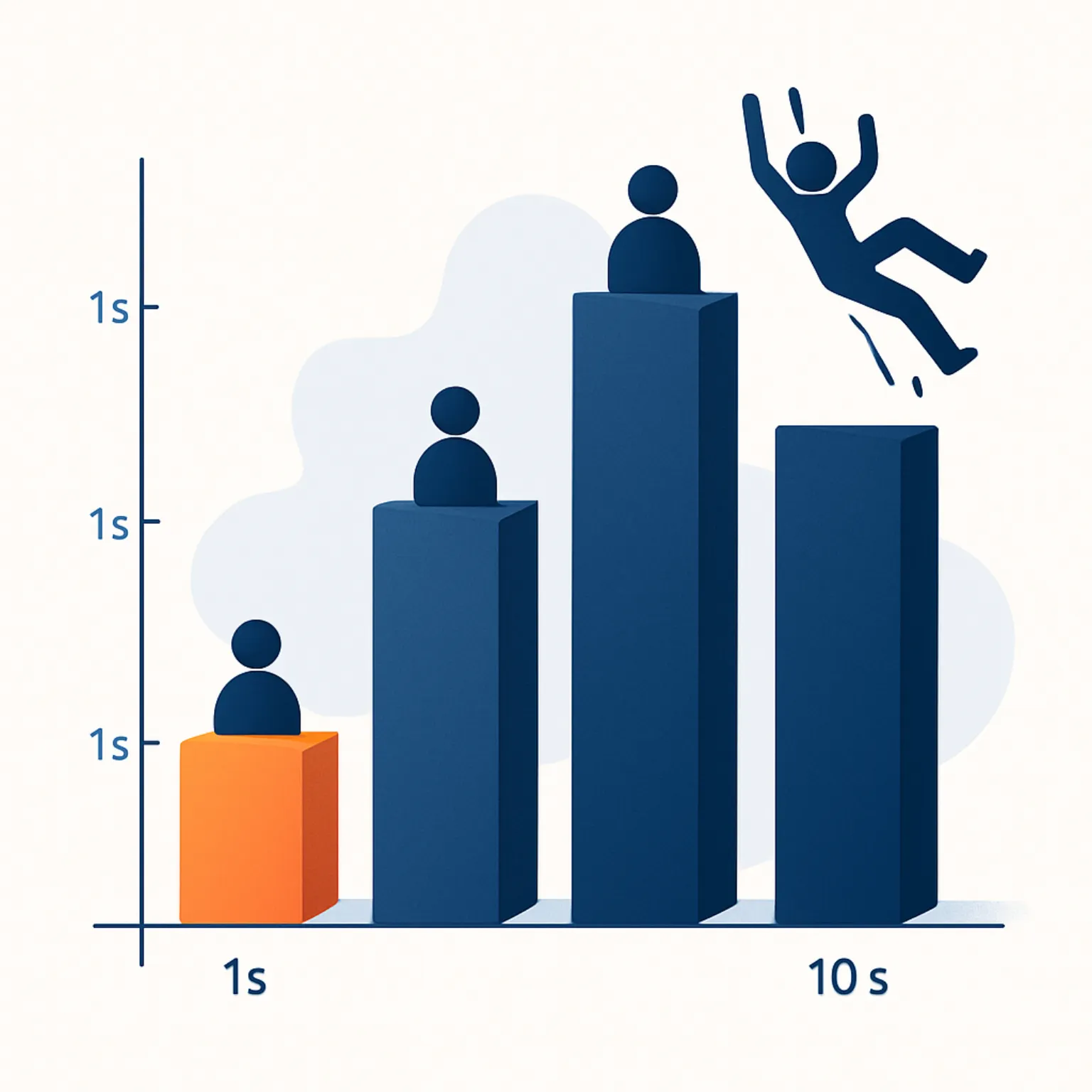
- Pages loading in 1 second convert 5x better than 10-second pages
- Pages loading in 1 second convert 3x better than 5-second pages
- A 1-second delay reduces conversions by 7%
- 70% of consumers say speed directly influences their purchase decision
- 45% won't return to a slow site — you permanently burn that customer
Quick example: A dentist's site loads in 5.5 seconds, gets 1,500 visitors. At 0.8% conversion: 12 inquiries. At 1.8 seconds with 3.5% conversion: 52 inquiries. At $800/patient, that's $32,000/month in lost revenue. The website rebuild costs $500. Payback: less than 12 hours.
Does Speed Affect Google Rankings?
Yes — 92% of top-ranking pages load in under 3 seconds (MarketingLTB, 2025). Faster sites get up to 15% better organic performance.
For local businesses in the map pack, this is decisive. Similar reviews, similar content, similar GBP? The faster site wins. And that advantage compounds: more visibility → more traffic → more reviews → higher ranking.
Why Are 80% of Small Business Sites Too Slow?
- Page builders (Elementor, Divi) add 0.8-2.2 seconds
- WordPress plugins (20+) make sites 40% slower
- Unoptimized images cause 40% of abandonment
- Cheap hosting accounts for 37% of slow loading
- No CDN — 48% of sites still lack one
What Does Ted Do Differently?
Ted-built sites avoid every trap above:
- Next.js — loads only what each page needs
- Automatic image compression — WebP format, lazy-loaded, perfectly sized
- Edge-cached hosting with CDN — served from the closest server
- Minimal JavaScript — no bloat
- HTTP/3 and Brotli compression
Result: 90-98 on PageSpeed. The average small business site scores 35-50. That gap translates directly to more visitors, more conversions, more revenue.
Test your speed at pagespeed.web.dev. Then get your free score at sitesByTed.com.